Big Change in NCERT Books! Class 9 Social Science book to Spotlight Indian Knowledge Systems.
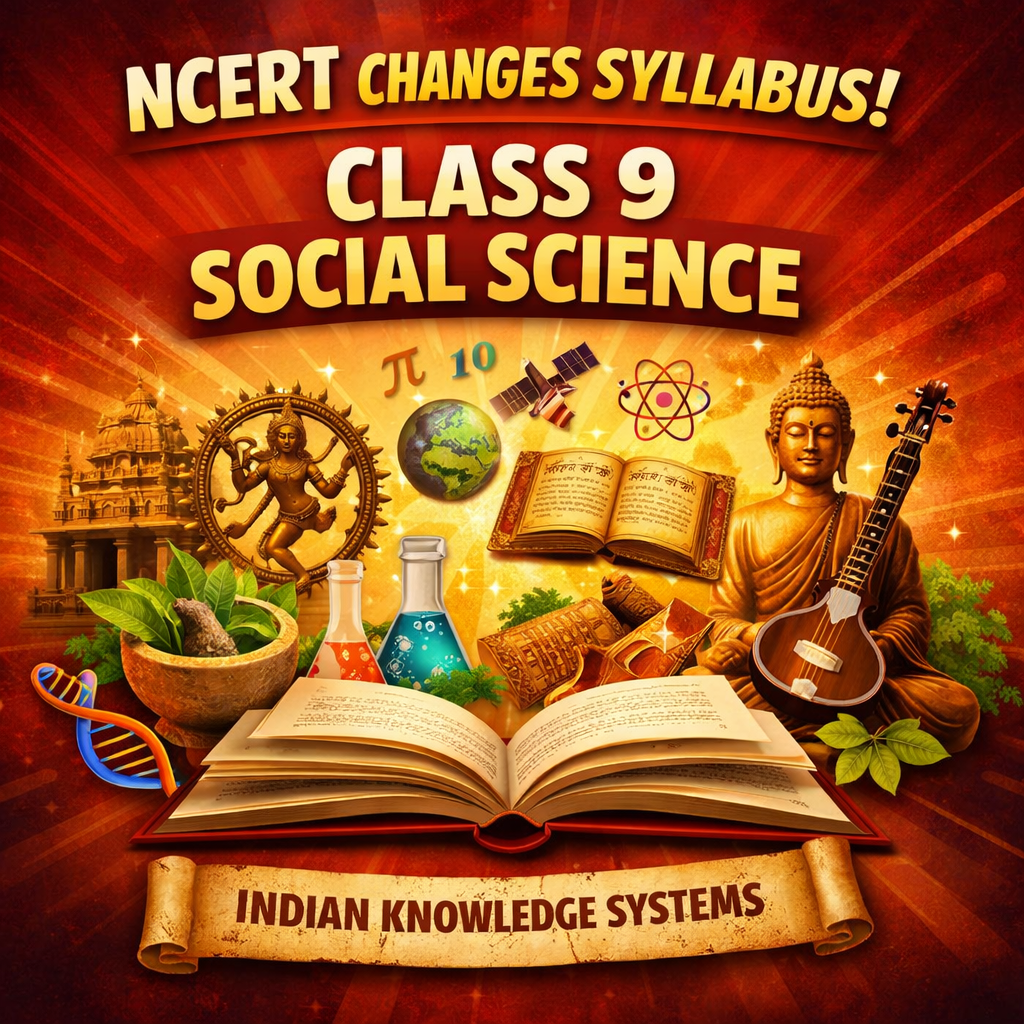
The revised NCERT Class 9 Social Science syllabus signals a clear departure from last year’s event-heavy, timeline-driven approach, turning the spotlight instead on India’s rich intellectual and cultural traditions.
.png)
Campus Times |Lucknow
The National Council of Educational Research and Training (NCERT) is set to release revised Class 9 Social Science textbooks in March, placing a strong emphasis on India’s indigenous intellectual and cultural contributions, according to the draft syllabus issued by the council.
As per the draft, the new textbooks will be designed around Indian Knowledge Systems (IKS) and will promote inquiry-driven learning rather than rote memorisation. The curriculum aims to present concepts through perspectives that are culturally rooted and closely connected to students lived realities.
The revised syllabus marks a shift from a largely event-driven and chronological approach followed in previous editions. Instead, it prioritises a deeper understanding of core concepts, encouraging critical thinking and conceptual clarity among students.
NCERT stated that the changes align with the objectives of the National Education Policy (NEP) 2020 and the National Curriculum Framework for School Education (NCF-SE) 2023, both of which advocate competency-based education and contextual learning.
Educators believe the updated textbooks will help students engage more meaningfully with social science by integrating India’s philosophical, scientific, and cultural traditions into classroom learning.
The new Class 9 books are expected to be introduced in schools across the country in the upcoming academic session.
What’s New for Class 9 Students
Under the revised NCERT syllabus, Class 9 students will explore India’s contributions across a wide range of disciplines, including mathematics, philosophy, science and technology, medicine, architecture, agriculture, literature, and art.
The curriculum places special focus on Indian philosophy, Ayurveda, yoga, horticulture, and the traditional use of herbs and spices. Students will also study etymology and the 22 shrutis of Indian classical music, analysing how these knowledge systems influenced the evolution of Indian society and history.
The updated content aims to help students understand India’s intellectual traditions not just as historical facts, but as living systems that have shaped everyday life and cultural practices over centuries. for more information... click here
Related to this topic: